
We wait all year for summer so we can shed the sweaters and heavy clothes and enjoy some fun in the sun. Unfortunately sun exposure, specifically, UV rays, have become more dangerous due to the thinning of earth’s protective ozone layer. The level of UV rays that reach the earth and us fluctuate throughout the year and throughout the day. Understanding how to protect your skin and your eyes from damage due to sun exposure is becoming more important.
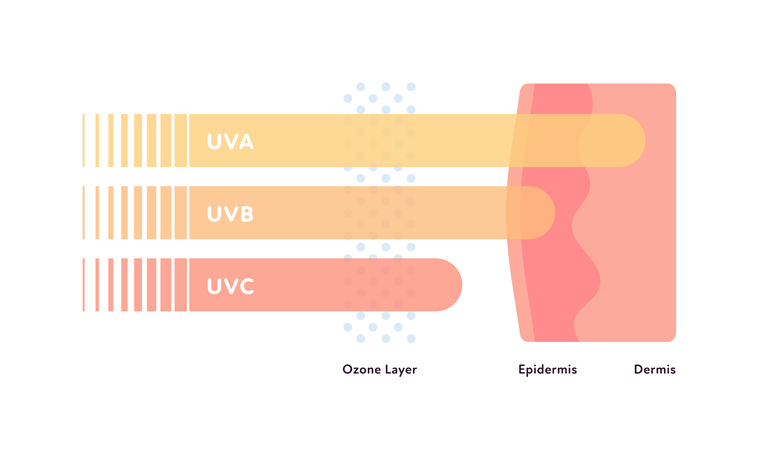
So what are UVA rays? Ultraviolet (UV) radiation is emitted by the sun and sources such as tanning beds. There are three primary types of UV radiation; ultraviolet A (UVA), ultraviolet B (UVB), and ultraviolet C (UVC). UVA and UVB radiation can both affect health, but UVA penetrates deeper into the skin and is more constant throughout the year.
UVA Rays
- Account for 95% of the UV radiation that reaches the Earth’s surface
- Used in tanning beds at amounts 10x – 13x higher than the sun
- Penetrates the second layer of skin (dermis)
- Causes wrinkles and premature aging of the skin
- Prevalent year-round at all times of the day
UVB Rays
- Primarily affects the top layer of skin and can cause burns in as little as 15 minutes
- Damages the collagen and DNA in your skin as weakening your immune system
- Causes cataracts, macular degeneration and other retinal disease
- Linked strongly to skin cancers, including melanoma
- Highest in intensity during Mid-May through fall between the hours of 10 a.m. and 4 p.m.
UVC Rays
- More energy than UVA or UVB rays, but do not get through the Earth’s atmosphere
- Not normally considered a risk factor for skin cancer
- Found in man-made sources of UC radiation (mercury lamps, welding torches)
Sunscreens
In today’s environment sunscreen should be applied to any part of your body exposed to the sun, even on an overcast day. Sunscreen should be applied every two hours and/or after swimming – even if “water resistant”. Not all sunscreens are the same and not all provide the type of protection from the harmful rays of the sun. Here’s what to look for:
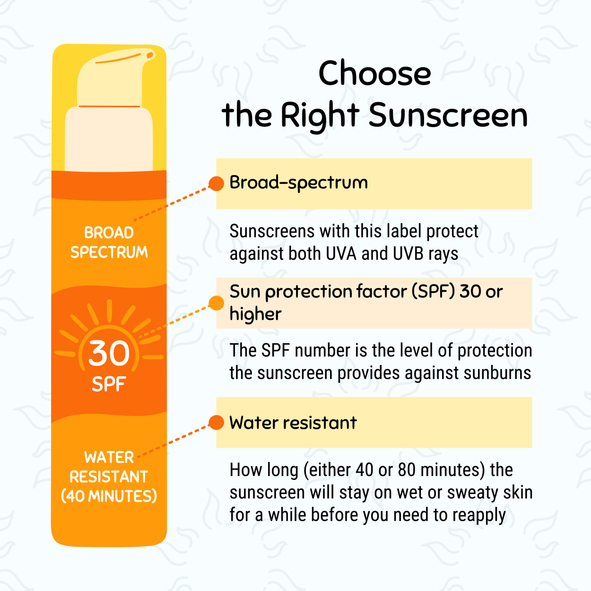
(1) Find a product that is broad spectrum. This will provide protection from both UVA and UVB radiation. (2)Look for a sunscreen that has a sun protection factor (SPF) of at least 30. This is a measure of the product’s ability to protect the skin from the redness (erythema) UVB rays for a period of time. Even 100 SPF should be reapplied every 2 hours to be safe.
(3) If you plan to participate in water sports look for water resistance. Keep in mind that water and chemicals will wash off some of the protection.
Check the UV Index Forecast

Also know as the UVI, the UV index measures of the level of UV radiation in the atmosphere during the day. Found on many online forecasts the index has a range from 0 – 11 and may appear as “UVI level 6” , “UV 9” or “High/low UV”. The higher the UVI the less time it will take and the more likely it is for the sun to damage your skin and your eyes*. Staying aware of the UV index will help you to choose your activities, the sun protection and to keep your family safe. Stay up on what the UV index is in your area. UV Index Search Tool…
Quick tips: Fun in the Sun Safety
- Avoid peak hours — 10 a.m. to 4 p.m.
- Wear protective clothing and stay in the shade when possible. Protective clothing is made with tightly woven fabrics that block the sun or contain SPF.
- Protect your head. Wear a hat with a brim that is at least three inches wide to protect your head and neck. Remember to apply sunscreen to your ears and back of your neck.
- Wear sunglasses with UV protection. Look for 100% protection against both UVA and UVB. 100% protection against UV 400 on the label.
- Don’t forget to put sunscreen on our feet or to wear shoes that cover the tops of your feet.
More ways to enjoy a healthy and happy summertime are in Summer Safety Tips and Tools…
 gdba
gdba 